What is Botlit and who is it for?
Botlit is an enterprise agentic AI platform designed to build, govern, and ship AI agents that run on your own models and answer from your organization's knowledge.
About this answer — Produced by our own assistant on 23 September 2026 from our published documentation. The pages it drew on are linked under the answer. It is generated text, not a statement from a person — where it and a linked page disagree, the page is right.
Answer
Botlit[1] is an enterprise agentic AI platform designed to build, govern, and ship AI agents that run on your own models and answer from your organization's knowledge. Rather than acting as a standalone chatbot builder, Botlit provides a centralized control plane where user-facing bot apps route requests to specialized AI agents with built-in version control, workspace-level RBAC, and per-execution audit logging.
Key capabilities outlined across Botlit Features[2] include:
- Bring Your Own Model (BYOM): Register 11 LLM provider types (including OpenAI, Anthropic, Google, Groq, Azure OpenAI, and AWS Bedrock) using vaulted credentials.
- Knowledge Bases & RAG: Ingest documents into vector collections with semantic search validation.
- Multi-Channel Deployment: Connect bots to Slack, Microsoft Teams, Discord, WhatsApp, and webhooks.
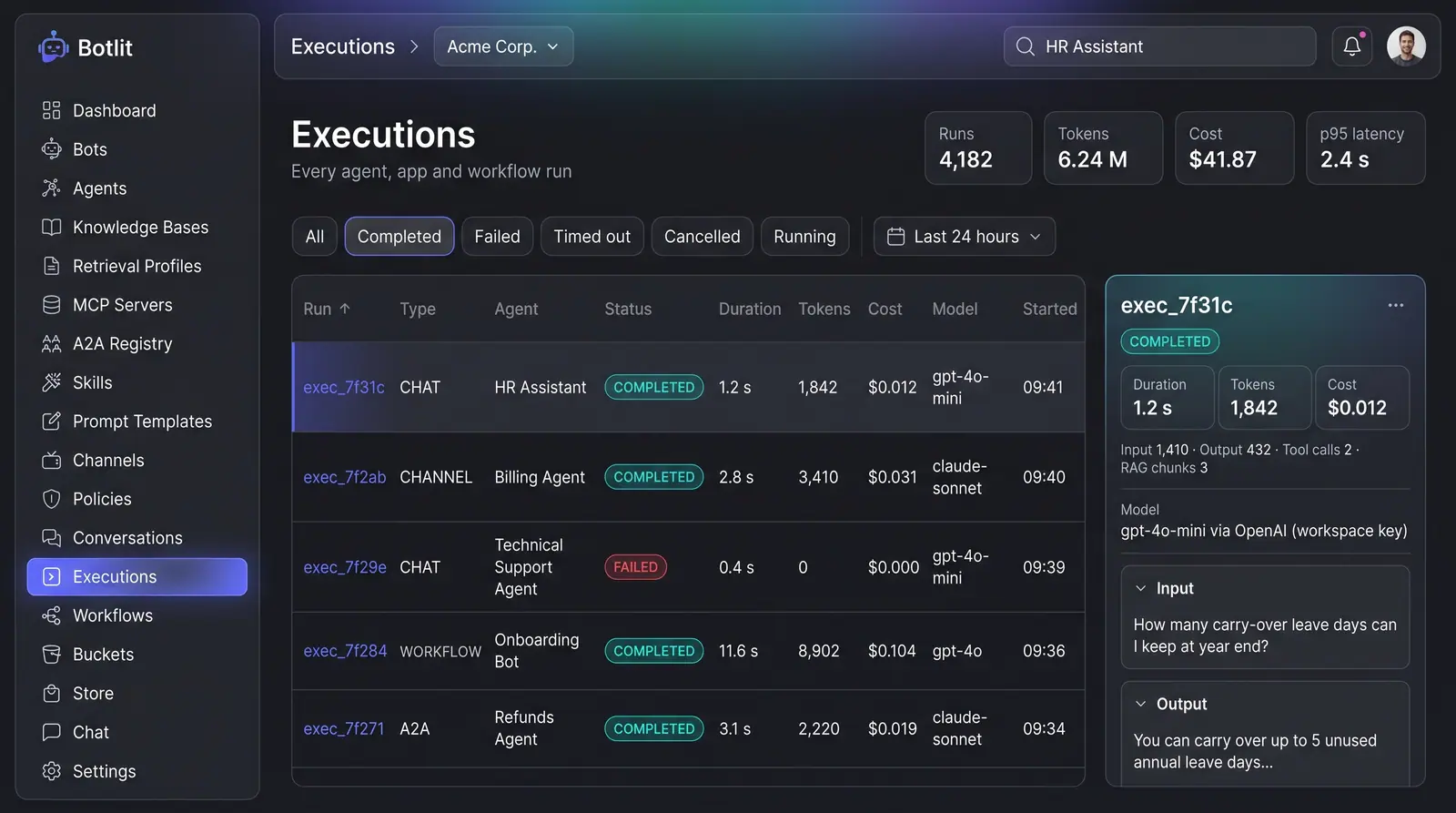
- Observability & Tooling: Inspect token usage and spend per run via the Execution Ledger and Run Costs[3], and connect external capabilities through MCP Tool Servers[4].
 (opens in a new tab)
Illustration of the concept, not a screenshot of the actual product — Execution Ledger and Run Costs[3]
(opens in a new tab)
Illustration of the concept, not a screenshot of the actual product — Execution Ledger and Run Costs[3]
Who is Botlit for?
According to Botlit's overview[1], the platform serves five primary groups:
- Enterprises (1000+): Organizations requiring governed, auditable agent fleets with enforced RBAC, policy guardrails, and private knowledge.
- Agencies & Consultants: Teams building and operating branded AI assistants for multiple clients in isolated workspaces.
- Mid-Market Companies (100–1000): Teams automating support, IT, and HR inquiries without staffing an internal ML team.
- Startups & Scale-ups: Fast-moving engineering teams shipping in-product AI assistants via an API-first approach.
- Healthcare Organizations: Providers seeking member-facing assistants with strict content and data-retention controls.
To see real-world scenarios, explore Botlit Use Cases[5] or sign up for early access on the Botlit Waitlist[6].
Sources
The pages this answer was drawn from.
- Botlit — Enterprise Agentic AI Platform for AI Agentsbotlit.ai(opens in a new tab)
- Botlit Features — Build, Version & Govern AI Agentsbotlit.ai(opens in a new tab)
- Execution Ledger and Run Costs — Concept | Botlitbotlit.ai(opens in a new tab)
- MCP Tool Servers and Live Tool Loop — Concept | Botlitbotlit.ai(opens in a new tab)
- Botlit Use Cases — Agentic AI Examples for Teamsbotlit.ai(opens in a new tab)
- Join Waitlist - Botlitbotlit.ai(opens in a new tab)