How do I find out what each agent run costs us, and attribute that spend per bot?
In Botlit, you can inspect individual inference costs and attribute spend using the Execution Ledger, which captures a runtime record for every agent turn, channel…
About this answer — Produced by our own assistant on 23 September 2026 from our published documentation. The pages it drew on are linked under the answer. It is generated text, not a statement from a person — where it and a linked page disagree, the page is right.
Answer
In Botlit[1], you can inspect individual inference costs and attribute spend using the Execution Ledger, which captures a runtime record for every agent turn, channel message, workflow, or delegated task.
Inspecting Per-Run Costs
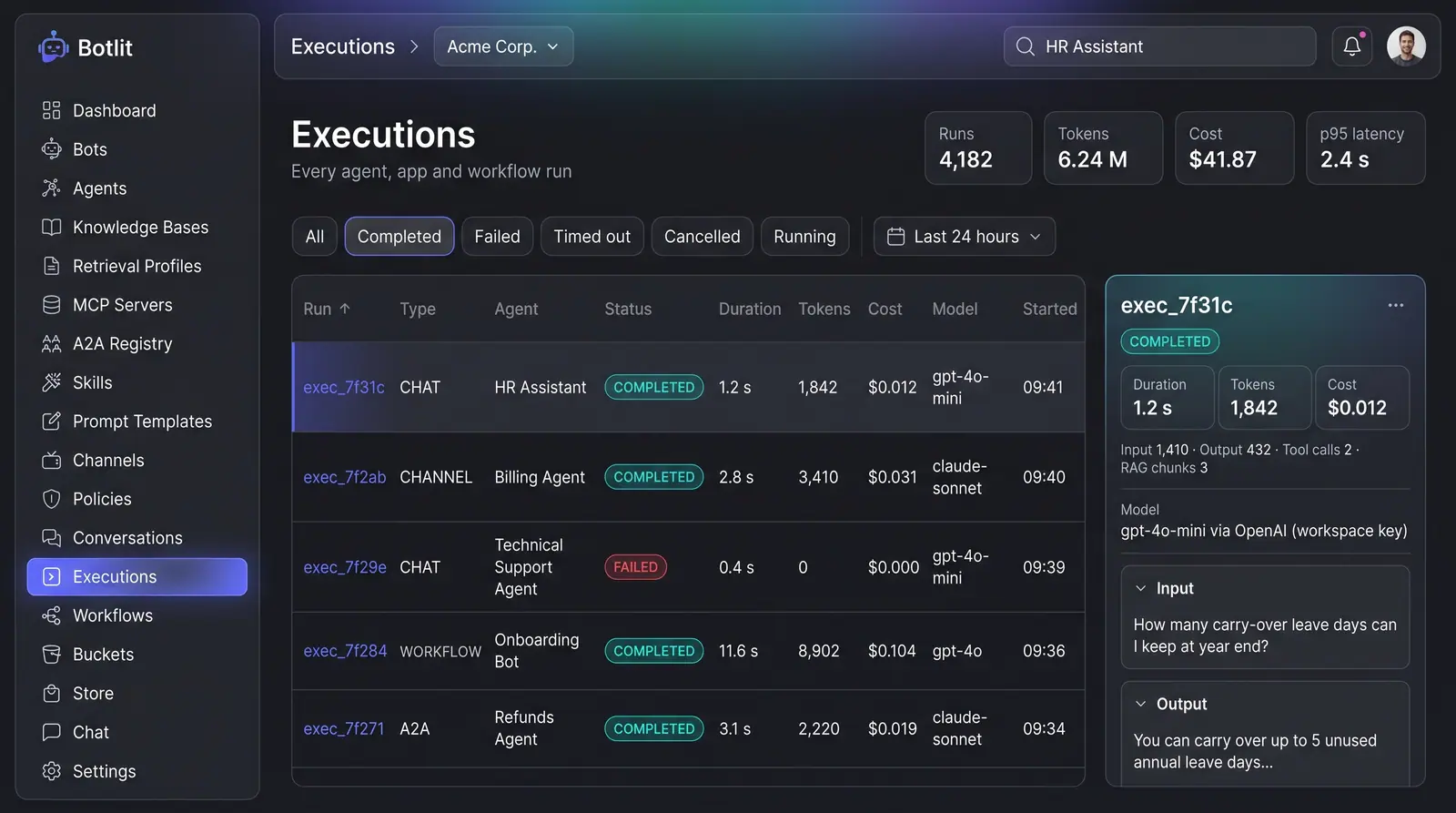
Under the workspace executions view, outlined in the Execution Ledger and Run Costs concept[2], every run is logged with its duration, status, model, tokens consumed, and resolved cost. Selecting any row opens a detail rail showing:
- Dedicated tiles for duration, total tokens, and run cost.
- A granular breakdown of input versus output tokens.
- The number of tool calls executed and knowledge chunks retrieved.
- Collapsible input questions and generated responses for full context.
 (opens in a new tab)
Illustration of the concept, not a screenshot of the actual product — Execution Ledger and Run Costs[2]
(opens in a new tab)
Illustration of the concept, not a screenshot of the actual product — Execution Ledger and Run Costs[2]
Attributing Spend Per Bot
You can attribute and monitor spend across your bots in several ways:
- Search and Filter: Filter the ledger by time window or search directly for a specific agent name to isolate that bot's runs and total spend.
- Per-Agent Rollups: As detailed in the AI Run Ledger use case[3], Botlit aggregates token usage and costs per agent and app, turning bot spend inquiries into simple queries rather than complex audit projects.
- Enforced Spend Limits: Workspace budget policies can cap token spend and run rates per agent to prevent unexpected model usage.
Because customer agents run on your workspace's own model provider keys, the ledger reflects direct provider spend rather than opaque platform credit abstractions.
To dive deeper into execution auditing and per-agent metrics, visit the AI Run Ledger use case[3].
Sources
The pages this answer was drawn from.