Analytics Answer Desk with Metric Citations
Answer data questions in team chat from agreed metrics and consoles, cite the version and freshness of each figure, and route the rest.
These images are illustrations of the concept, not screenshots of the actual product.
Overview
In a data and analytics team, the ask-data channel fills with the same questions every week: what were returns last week, how much stock is on hand, what is the margin on one channel. Answering by hand means finding the agreed definition, the right console and the latest load, and a figure from a stale source can spread before anyone notices. This Botlit concept shows an answer agent for that channel, designed to answer routine questions from SemanticFed's published metrics and BigConsole consoles, to say where every figure came from and how fresh it is, and to hold back when the data is not ready.
The illustration opens the Conversations view of an Ask Data agent for a sample company, badged active, with a badge for the team's ask-data channel and a Metrics: asker's access badge. The design envisions metric answers running through SemanticFed's governed model under the asker's own access policy, while answers read from a console follow that console's sharing. Asked about returns at a group of stores, the agent gives a returns figure and its share of net sales against the week before. Three numbered citations sit beneath: two SemanticFed metrics from a versioned retail model and a BigConsole console with its region filter, beside a Data as of badge. A Sources for this answer panel lists the metric with its model version and publish date, the console with its widget count, and a returns source covering all channels with its last refresh time.
The next two questions show the agent declining to guess. Asked about tent stock, it replies in an amber card that the inventory source is late against its four-hour target and that it will not quote stock until the source refreshes, flagged by a BigConsole freshness board. Asked about margin through wholesale partners, it says no published metric covers that yet; a No matching metric badge sits above a line showing the question was filed as a numbered request in PlanMagnet through FluidGrids. A Today card counts the day's questions, those answered with citations, those held for late data and those sent to the data team.
In the design, Botlit handles the conversation, SemanticFed supplies the agreed definitions, and BigConsole supplies consoles and freshness signals. A FluidGrids workflow is designed to turn questions no published metric covers into PlanMagnet requests, so the data team sees demand instead of losing it in chat. Each answer is designed to be kept in Botlit's execution records with its tokens and cost. The concept is meant for analytics and BI teams, metric owners and the colleagues who bring them questions.
What this concept shows
- Answers in the team's ask-data channel drawn from SemanticFed metrics and BigConsole consoles
- Numbered citations naming each metric with its model version and each console with its filter
- A Data as of badge and a sources panel with the publish date, widget count and last refresh time
- Metric answers designed to run under the asker's own access, and console answers under the console's sharing
- Figures held back with a stated reason when a BigConsole freshness board flags a late source
- Questions no published metric covers filed as PlanMagnet requests through FluidGrids
- Daily counts of questions, cited answers, answers held for late data and questions sent to the data team
How it works
- A colleague asks a data question in the team's ask-data channel, and the Ask Data agent picks it up.
- The agent is designed to look for a published SemanticFed metric or a BigConsole console that answers it, applying the asker's access.
- If the source is fresh, it answers and cites the metric and model version, the console and filters read, and the data source with its last refresh.
- If a BigConsole freshness board flags the source as late, the agent says so and holds the figure until the data refreshes.
- If no published metric covers the question, a FluidGrids workflow is designed to file it as a request in PlanMagnet for the data team.
- The data team reviews the day's counts of cited answers, held answers and questions sent their way.
Who it's for
- Analytics and BI teams
- Metric and data platform owners
- Business analysts and managers who ask data questions
- Data team leads who triage requests
Illustrations
1 illustration of this concept. Select one to view it full size.
Ask-Data Channel With Cited Metric Answers
This desktop illustration shows the Conversations view of an Ask Data agent in Botlit for a sample company, with an active badge, a channel badge and a Metrics: asker's access badge. Three sample questions from colleagues fill the thread. The first answer gives a returns figure and its share of net sales, cited to two SemanticFed metrics from a versioned retail model and a BigConsole console filtered to one region, with a Data as of badge. The second, in an amber card, says an inventory source is late against its four-hour target and declines to quote stock, flagged by a BigConsole freshness board. The third says no published metric covers wholesale margin, with a No matching metric badge and a note that it was filed as a PlanMagnet request via FluidGrids. On the right, Sources for this answer lists the metric with its model version and publish date, the console's widget count and the returns source's refresh time, above a Today card of four counts.
Topics
- ask data chatbot
- analytics question answering agent
- metric citations in chat
- governed metrics answers
- semantic layer chatbot
- data freshness check
- self-serve analytics questions
- late data warning
- data request intake
- metric version citation
Related concepts
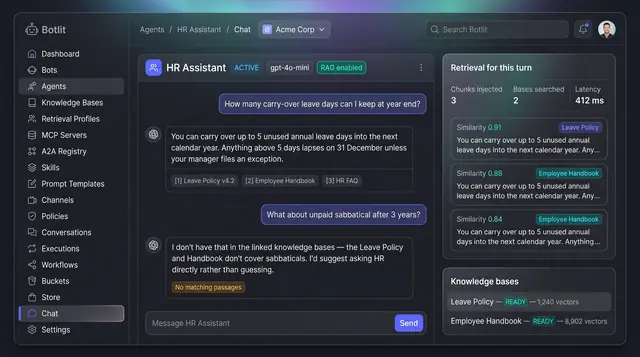
Grounded Answers with Cited Sources
Agents answer from your own knowledge bases, show the passages they used, and say so plainly when nothing matches.
1 illustration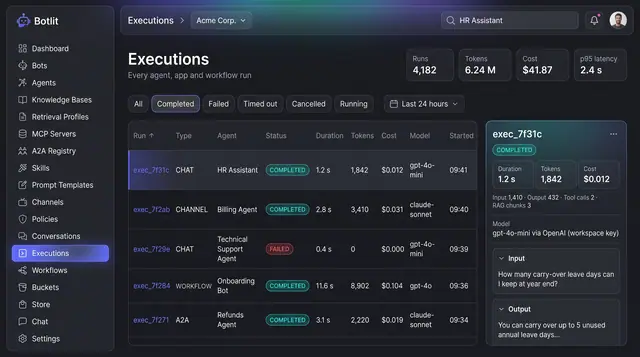
Execution Ledger and Run Costs
Every agent, channel and workflow run recorded with its status, duration, tokens, cost and the model that produced it.
1 illustration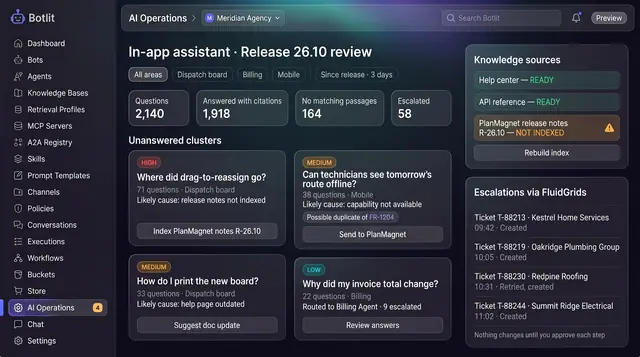
In-Product Assistant Gap Review
After every release, see which in-app questions went unanswered, why, and the next step for each cluster.
1 illustration
Part of an industry solution
This concept appears in a cross-product solution on burdenoff.com — see how it works alongside other Burdenoff products to solve a problem in that industry.