Grounded Answers with Cited Sources
Agents answer from your own knowledge bases, show the passages they used, and say so plainly when nothing matches.
These images are illustrations of the concept, not screenshots of the actual product.
Overview
Grounded answers is the Botlit concept for a chat experience in which an agent replies from the knowledge bases a team has linked to it rather than from general model knowledge, and shows its work while doing so. The illustration opens a sample HR Assistant agent in its chat view, reached through a breadcrumb that runs from Agents to the agent and then to Chat. The header carries an active status, a tag naming the model behind the agent, and a badge confirming that retrieval is switched on.
The problem the concept addresses is trust. An internal assistant that answers policy questions fluently but without sources is difficult to rely on, and one that improvises when the documentation is silent can do real damage. The design answers both halves. A grounded reply in the sample conversation explains how many unused leave days carry into the next year and then lists numbered source chips naming the documents behind it, in this case a leave policy, an employee handbook and an HR FAQ. A follow-up question about an unpaid sabbatical, which the linked documents do not cover, produces a direct statement that the agent does not have that information, a suggestion to ask the HR team instead, and a tag reading No matching passages.
A side panel headed Retrieval for this turn makes the retrieval step inspectable rather than implied. It summarizes how many chunks were injected into the answer, how many knowledge bases were searched, and how long retrieval took, then lists each retrieved passage as a card with a similarity score, a short excerpt and a badge naming the base it came from, ordered from the closest match down. Beneath it, a Knowledge bases card lists the bases linked to the agent, each showing a ready state and a vector count, so a reader can confirm the linked bases are indexed before relying on an answer.
The concept sits inside the wider Botlit workspace rather than standing alone. The same left navigation lists Knowledge Bases and Retrieval Profiles alongside MCP Servers, the A2A Registry, Policies and Executions. Related Botlit concepts pick up the thread: the execution ledger records a chat run for the same sample question with its tokens, cost and a count of three retrieved chunks, and the policy page shows the limits on what agents may accept and emit.
What this concept shows
- Grounded replies carry numbered source chips naming the documents behind the answer
- An explicit decline, tagged No matching passages, when the linked bases do not cover a question
- A per-turn retrieval panel reporting chunks injected, bases searched and retrieval latency
- Retrieved passages ranked by similarity, each card carrying its score, an excerpt and a source badge
- An agent header showing an active status, the model in use and a retrieval-enabled badge
- A knowledge bases card listing each linked base with a ready state and a vector count
- A workspace switcher, global search and notifications in the top bar of the chat view
How it works
- Open an agent from the Agents section and switch to its Chat view, where the header confirms its status, model and retrieval setting.
- Ask a question in the message field and read the reply together with the numbered citations listed under it.
- Review the retrieval panel beside the conversation to see how many chunks were injected for that turn, how many bases were searched and how long retrieval took.
- Compare each retrieved passage and its similarity score against the answer to confirm the reply is faithful to the source.
- Ask something outside the linked documents and watch the agent decline rather than guess, with the turn tagged accordingly.
- Check the knowledge bases card to confirm every linked base is indexed and ready before acting on the answer.
Who it's for
- HR and people-operations teams publishing policy assistants
- Knowledge managers who maintain the underlying documents
- Workspace admins accountable for agent accuracy
- Compliance reviewers who need to trace an answer back to a source
Illustrations
1 illustration of this concept. Select one to view it full size.
Agent chat with citations and a per-turn retrieval panel
This desktop illustration shows the chat view for a sample HR Assistant agent, with a left navigation column listing the workspace sections and a breadcrumb from Agents through the agent to Chat, beside a workspace switcher, a search field and notifications. The agent header shows an active status, a model tag and a retrieval-enabled badge. In the conversation, a question about carrying over unused leave days receives a direct answer followed by three numbered source chips. A second question about an unpaid sabbatical returns a statement that the linked documents do not cover it, a suggestion to ask HR directly, and a no-matching-passages tag. The right rail reports chunks injected, bases searched and retrieval latency, then lists three retrieved passages in descending similarity order, each with its score, a truncated excerpt and a badge for its source base. A knowledge bases card below lists two linked bases, both ready, with their vector counts. A message field and a send button close the chat column.
Topics
- grounded AI answers
- chatbot with citations
- retrieval augmented generation
- knowledge base assistant
- AI answer sources
- similarity score retrieval
- HR policy assistant
- chatbot that declines when unsure
- reduce AI hallucinations
- enterprise knowledge chat
Related concepts
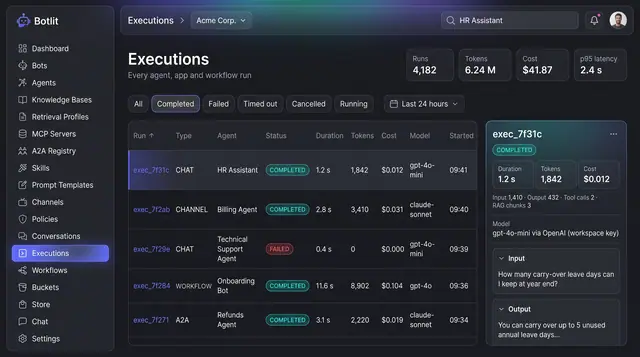
Execution Ledger and Run Costs
Every agent, channel and workflow run recorded with its status, duration, tokens, cost and the model that produced it.
1 illustration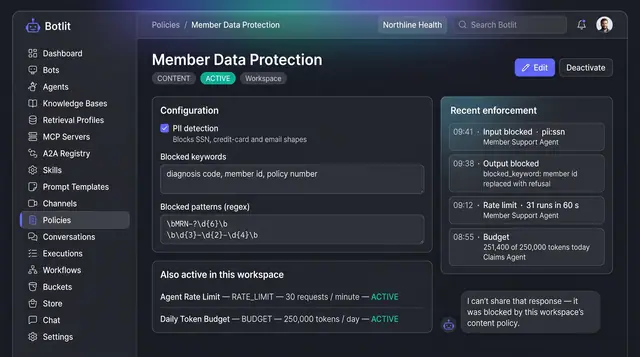
Content Policies and Guardrails
Workspace policies that block unsafe input and output, cap request rate and token spend, and list recent enforcement events.
1 illustration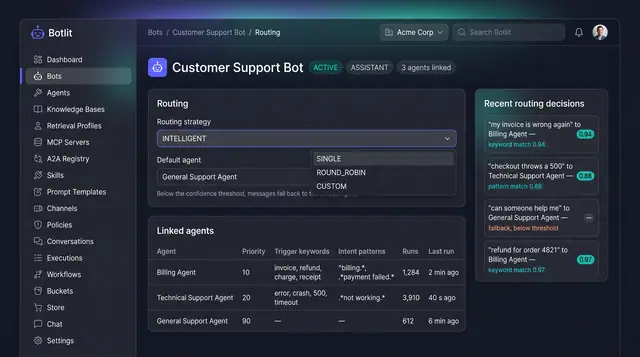
Intelligent Routing and Agent Delegation
A bot sends each message to the right specialist agent, and agents hand work to one another inside trust and depth limits.
2 illustrations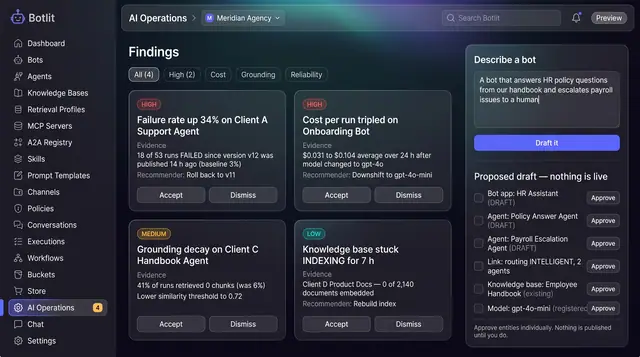
AI Operations Findings and Bot Drafting
An operations copilot that flags regressions across your bots and drafts a new one from a plain-language description.
1 illustration