Newspaper Archive Reader Answer Desk
Readers ask what the paper has reported and get a short answer citing dated stories, with corrections stated and restricted items held back.
These images are illustrations of the concept, not screenshots of the actual product.
Overview
In publishing and information services, a newspaper's archive holds years of reporting that readers rarely find through search: what the paper has said about a bridge, a school consolidation or a council race. An answer desk can surface it, but only if it quotes accurately, admits when a story was corrected, holds back material the publisher can no longer show, and respects the paywall. This Botlit concept shows a reader-facing archive agent for a publisher's website and app, built on Botlit knowledge bases, channels and policies.
The illustration shows the Conversations view of an Archive Desk bot for a sample local paper, badged active and tagged for web and app. Tiles count questions answered today and questions with nothing in the archive, above topic chips for a bridge, a school consolidation, a harvest fair and a council race. A reader asks what the paper has reported about a local bridge since 2019. The answer is a few sentences summarizing three stories, and it states a correction in its own words: an earlier version of one story gave a different contract figure and was fixed on a stated date. Three citations follow, each with a headline, date and byline, and a line notes that two passages were held back by archive rules.
When the reader asks to read the inspection story, the agent explains that it is for subscribers and offers its headline and summary, with a subscription card, a See subscription offers button and a Sign in button. A Checks for this answer card on the right records three checks: SemanticFed archive rules with two passages withheld, TheCulturePost corrections with one stated, and the paywall reading the visitor as a free reader. A Coverage gaps this week card lists questions the archive could not answer, each sent to the archive desk.
Passages are designed to reach the agent only through SemanticFed's takedown and wire limit rules, so lapsed wire copy, removed stories and anonymized names are held back and counted for staff. Corrections recorded in TheCulturePost are designed to be stated in the answer rather than left to a badge, and the publisher's paywall still decides who can open a full story. Questions the archive cannot answer are designed to collect in a weekly coverage-gap list for the archive desk and the newsroom. The concept is meant for audience, archive and digital product teams at newspapers, magazines and information providers.
What this concept shows
- Short archive answers that cite dated stories by headline, date and byline
- Corrections stated in the answer itself, drawn from TheCulturePost
- Passages held back by SemanticFed archive rules and counted in the answer
- Subscriber-only stories answered with a headline, a summary and a subscription offer
- A per-answer checks card for archive rules, corrections and paywall status
- A weekly coverage-gaps list of unanswered questions sent to the archive desk
- Tiles for questions answered today and questions with nothing in the archive
How it works
- A reader asks the Archive Desk on the publisher's website or app what the paper has reported on a topic.
- Passages are designed to pass through SemanticFed's takedown and wire limit rules before the agent sees them.
- The agent answers in a few sentences, cites dated stories and states any correction recorded in TheCulturePost.
- If the reader asks for a subscriber story, the paywall decides, and a free reader gets the headline, a summary and a subscription offer.
- Questions the archive cannot answer are designed to collect in a weekly coverage-gap list for the archive desk and the newsroom.
Who it's for
- Audience and reader revenue teams
- Newspaper archive and library desks
- Digital product teams at publishers
- Newsroom editors
- Information service providers
Illustrations
1 illustration of this concept. Select one to view it full size.
Archive Desk Answer With a Correction and a Paywall
This desktop illustration shows the Conversations view of an Archive Desk bot in Botlit for a sample local newspaper, badged active and tagged for web and app. On the left, tiles count questions answered today and questions with nothing in the archive, above a column of topic chips. A reader asks what the paper has reported about a bridge since 2019; the agent summarizes three stories, states a correction to an earlier contract figure with the date it was fixed, cites three stories by headline, date and byline, and notes two passages held back by archive rules. The reader asks to read the inspection story, and the agent explains it is for subscribers, offering its headline and summary with a subscription card, a See subscription offers button and a Sign in button. On the right, Checks for this answer ticks SemanticFed archive rules, TheCulturePost corrections and the paywall, and Coverage gaps this week lists three unanswered questions sent to the archive desk.
Topics
- newspaper archive chatbot
- news archive search assistant
- reader question answering
- cited news answers
- corrections in AI answers
- paywall-aware chatbot
- wire copy rights limits
- archive coverage gaps
- publisher AI assistant
- local news archive
Related concepts
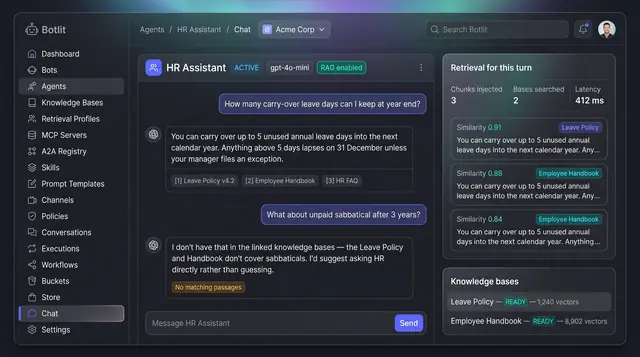
Grounded Answers with Cited Sources
Agents answer from your own knowledge bases, show the passages they used, and say so plainly when nothing matches.
1 illustration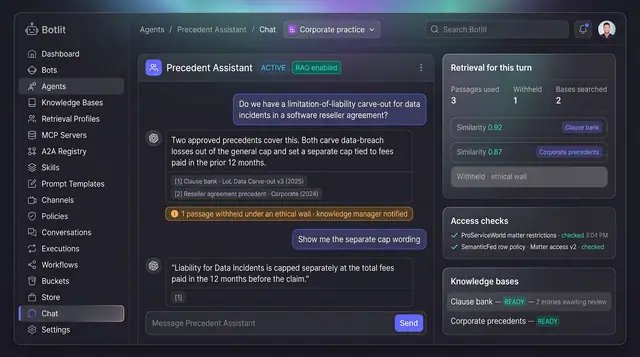
Ethical-Wall-Aware Precedent Answers
Ask the firm's precedent bank a drafting question and get cited clauses, with anything behind an ethical wall withheld and said so.
1 illustration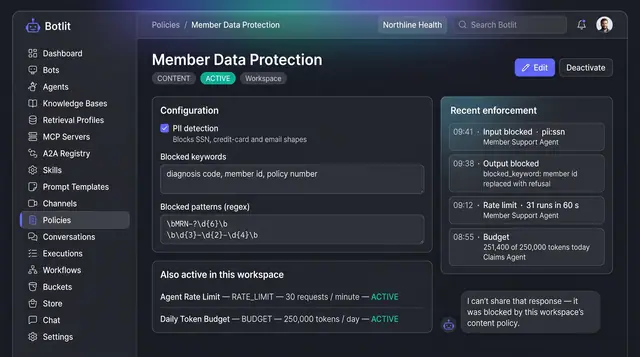
Content Policies and Guardrails
Workspace policies that block unsafe input and output, cap request rate and token spend, and list recent enforcement events.
1 illustration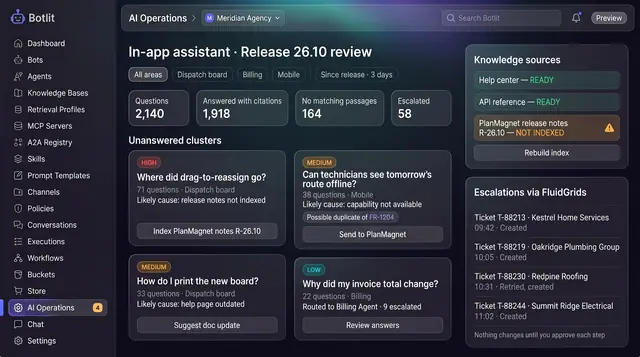
In-Product Assistant Gap Review
After every release, see which in-app questions went unanswered, why, and the next step for each cluster.
1 illustration
Part of an industry solution
This concept appears in a cross-product solution on burdenoff.com — see how it works alongside other Burdenoff products to solve a problem in that industry.